Editor score 4.2 / 5
If you're looking at a The North Face winter jacket through fashion-reps and need to fit it in your luggage, the real question isn't just "can it be compressed" — it's whether the page evidence is enough to judge its volume, structure, and rebound risk.
This guide is for buyers who have found a candidate item and are comparing luggage space with warmth needs. After reading, you should be able to do three things: confirm whether the page shows a jacket, vest, or something else; estimate compression risk from the fill, fit, and storage bag info; and make a checklist of things to verify on the product page or QC photos before ordering.
This guide does not cover scenarios requiring precise packed dimensions, airline baggage weight, or extreme cold guarantees. The current visible data doesn't provide folded dimensions, compressed weight, rebound tests, or independent warmth tests, so treat page descriptions as catalog info, not lab results. 🧳
Verification date: October 8, 2026. The following assessment is based on visible catalog info and QC photo links on the fashion-reps page; price, stock, page status, agent fees, and international shipping should all be re-confirmed before ordering.

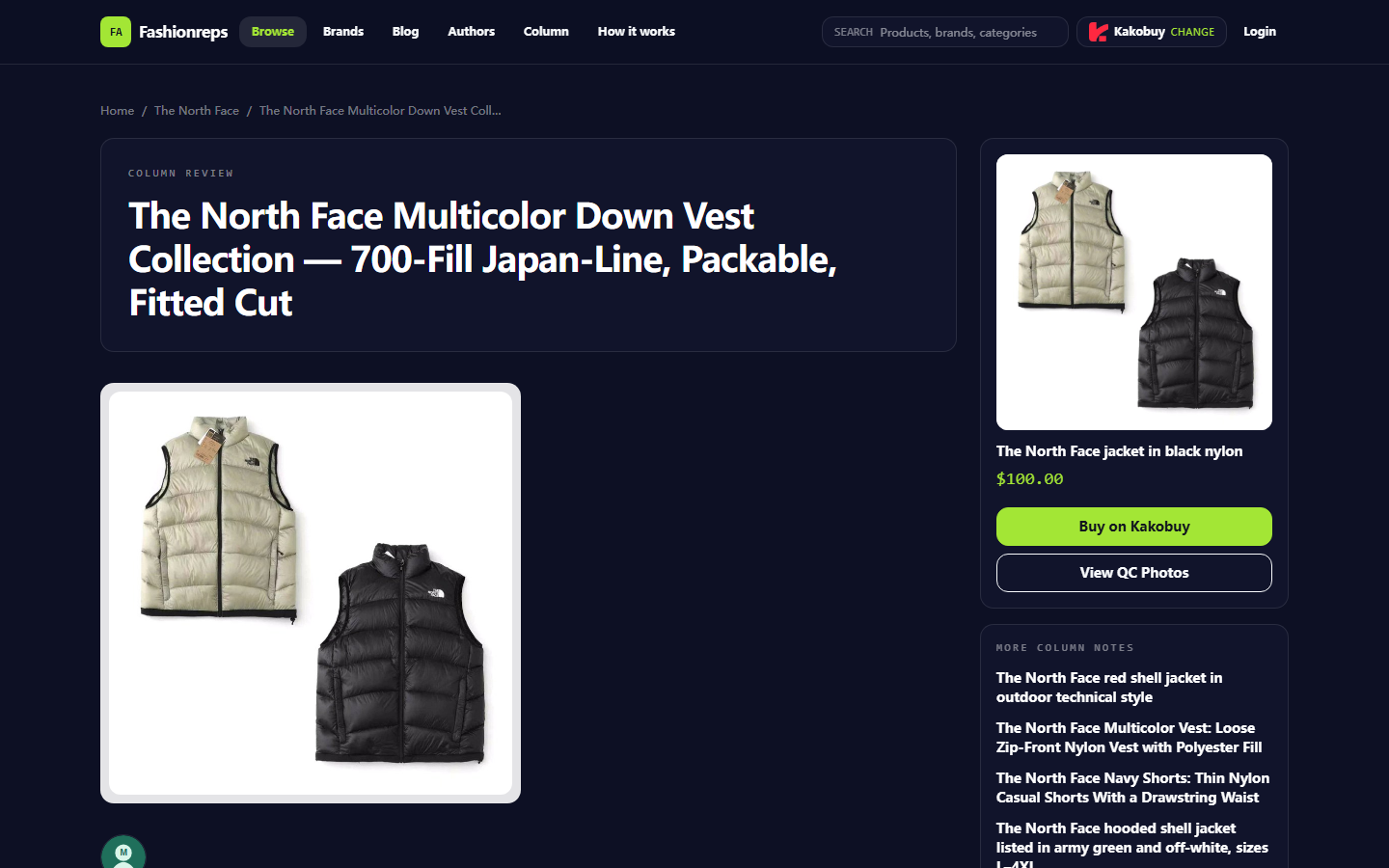
Image: Screenshot of the fashion-reps product page showing The North Face lightweight down vest collection. Source: on-site product page screenshot, used to illustrate visible page info only.
For Buyers Who Need to Pack The North Face Winter Jackets in Luggage
First, separate the product name from the article title. The current page title reads "The North Face Multicolor Down Vest Collection," and the content repeatedly uses "down vest" — that's a down vest, not a universal sample representing all The North Face winter jackets.
This means the page can help you judge a lightweight down layer's packing approach, but you cannot assume that heavy down jackets, hardshells, hooded styles, or long coats will all achieve the same luggage volume.
Useful info the page provides:
- Catalog lists 700-fill down, with 90% white duck down content.
- Outer described as ripstop nylon with light water-repellent treatment.
- Page states the item comes with a storage bag and can be packed into it.
- Page says this is a fitted cut, suitable for commuting or as a mid-layer.
- Page gives chest, length, shoulder, and hem measurements for S to XL.
- A single source note suggests it's better for commuting, mild winters, or layering, not extreme cold.
This info supports a preliminary judgment that lightweight down layers may be more travel-friendly, but it doesn't prove specific compressed dimensions or that it fully regains loft after long compression.
First Verify the Style, Size, and Visible Structure on the Target Product Page
When you open a candidate item on fashion-reps, the first step isn't comparing prices — it's confirming what style the page actually shows. The product name, images, size chart, and description must all point to the same item.
The size chart visible on this page:
| Size | Chest | Length | Shoulder | Hem |
|---|---|---|---|---|
| S | 55 cm | 67 cm | 43.6 cm | 53.5 cm |
| M | 57 cm | 69 cm | 45 cm | 55.5 cm |
| L | 59 cm | 71 cm | 46.5 cm | 57.5 cm |
| XL | 61 cm | 73 cm | 48 cm | 59.5 cm |
The page does not give garment weight, fill weight, folded dimensions, or packed dimensions. So the size chart only helps you assess fit and space trends, not actual volume.
If you need to wear a thick sweater underneath, don't just look at the chest number. The page describes this as a fitted cut, meaning it's probably not a boxy, loose fit. You should factor in your base layer thickness, shoulder mobility, and armhole position. For a true winter jacket, also check for hoods, thick linings, longer body, heavy placket, and larger pockets — all of which affect packed volume.
What Page Evidence Supports Packed Volume Assessment
Evidence for travel packability can be split into three layers.
First layer: explicit structural info on the page. Here, it mentions 700-fill, lightweight down, nylon shell, and a storage bag. This supports a directional judgment that compressibility may be higher than heavy hardshells or structured coats, but it's still catalog info.
Second layer: structure visible in product images. You can observe quilting width, body thickness, collar height, hood presence, zipper area, and any obvious stiff support layers. Images only support visible structure judgment, not feel, weight, or warmth.
Third layer: QC photos or supplemental measurements. If the page provides flat-lay photos, look at whether the garment is fully spread, whether the storage bag is shown, whether the ruler is parallel to the garment, and whether the image clearly shows style and size. If photos only show parts or lack scale, don't treat them as precise dimensions.
The current page has a QC Photos link, but the provided materials don't show compressed dimensions or independent fill weight measurements. So before ordering, you still need to list these as items to verify: does it actually fit into the storage bag, what are the bag's dimensions, and does it recover after compression. 🔎
Trade-offs: Folding, Hanging, and Compression Packing
Lightweight down layers and items with storage bags are usually easier to arrange in luggage than heavy, structured coats, but different methods carry different risks.
| Packing Method | Potential Benefits | Main Risks | Better For |
|---|---|---|---|
| Flat folding | Reduces localized pressure, easy to place on top | Takes up more flat area | Wide suitcase, minimal movement |
| Using original storage bag | Convenient, page explicitly mentions included bag | Page gives no bag dimensions or long-term compression impact | Need to save side space, not extreme compression |
| Vacuum or forceful compression | May significantly reduce initial volume | May increase fabric, down rebound, and moisture risks; cannot guarantee warmth retention | Only if care label allows and space is critical |
| Hanging transport | Reduces long-term folding | Requires extra space, may not be feasible in transit | Destination has hangers, garment wrinkles easily |
We can't conclude "smaller is better" here. Saved space may come with slower rebound, moisture issues that don't recover easily, or the need to re-fluff on arrival. For down items, follow care labels and seller instructions; don't interpret "packable" as suitable for long-term hard compression.
For flights or short trips, the safer approach is to use the original storage bag first, then place it in the middle layer of your suitcase, away from shoe soles, hard chargers, or sharp objects. After arrival, take it out promptly, lay flat or hang to recover. This is risk management advice, not a tested conclusion about this item's rebound.
How to Arrange the Jacket with Other Clothing in Winter Travel Luggage
Luggage arrangement should consider volume, use order, and pressure risk. If the candidate is indeed a lightweight down vest or thin down layer as described, you can place it in the middle of your clothes, separated by soft knits or T-shirts. The goal is to reduce hard objects pressing directly on quilted areas, not to minimize volume.
For a full winter jacket, especially hooded, thickly lined, or longer styles, estimate space separately from shoes, toiletry bags, and other dense items. Don't assume it can use the same packing solution as a lightweight vest just because the page says "packable."
For frequently accessed outerwear, put it on top or in a separate garment bag. For thick items only needed after arrival, you can use the original storage bag within care limits, but avoid using compression bags as long-term storage.
Also consider luggage weight. Compression reduces space, not weight. If your destination has weight limits, you need to check garment weight, bag weight, other clothing weight, and airline rules. The page lacks garment weight, so you cannot calculate exact luggage weight from 700-fill or the size chart.
What Volume, Rebound, and Warmth Evidence the Page Doesn't Provide
The current data has several clear gaps:
- No folded dimensions.
- No packed dimensions after using storage bag.
- No garment weight or fill weight.
- No long-term compression rebound record.
- No independent warmth or temperature rating tests.
- Insufficient evidence of outer shell performance in continuous rain/snow.
- No multi-source user feedback representing typical wear.
The page shows a reference price of $100.00, plus a final item price display of $109.52; service fees and international shipping must be re-confirmed on your chosen shopping agent's site. Price is not evidence of packing performance, nor can it infer fill volume, material grade, or after-sales results.
The page also clearly states that independent buyer review data is limited, and fit/warmth judgments are directional only. There are no approved customer reviews, so don't treat words like "warm" or "water-repellent" as completed independent tests.
Pre-Order Checklist for Product Info and QC Photos
Before ordering, go through this checklist:
- Does the product title clearly match the style you want, not mixing vests, jackets, down coats, or other lines?
- Do the product images' color, collar, sleeve length, hood, and pockets match the title?
- Does the size chart include chest, length, shoulder, etc., with clear units?
- Have you added your base layer thickness into chest and shoulder mobility assessment?
- Does the page clearly state the storage bag is included or sold separately?
- Do QC photos show the full garment, size tags, main seams, zippers, and fill distribution?
- Are there flat-lay measurement photos with understandable methods and units?
- Are there obvious down leakage, severe unevenness, seam issues, broken zippers, or stains that need pre-shipment resolution?
- Have you confirmed the shopping agent, item price, service fees, international shipping, possible taxes, and destination import requirements?
- If the item needs return/exchange, is it within the seller or agent's handling window?
Do not share order numbers, full shipping labels, payment card info, passport info, or addresses in public discussions or screenshots. When saving QC records, cover personal info and keep original screenshots with verification dates.
Final Action: Decide Whether to Keep the Candidate Based on Your Luggage Scenario
If your main goal is packing a lightweight down layer, the page's 700-fill, nylon shell, fitted cut, and included storage bag info supports further verification. Potential benefit: it likely takes less space than a heavy winter coat, and the original bag helps organize; but without compressed dimensions or rebound tests, space and volume savings can't be calculated precisely.
If you need extreme cold warmth, roomy layering space, exact airline weight budget, or must know precise packed dimensions, current page evidence is insufficient. Don't order based on this catalog info alone. Request actual measurements, fill weight, full QC photos, and care instructions, or choose a candidate with more complete evidence.
Final decision framework:
- Lightweight travel, short-term packing, accept directional judgment: keep candidate, verify size and QC photos first.
- Need to fit in small carry-on: get actual storage bag dimensions first, don't rely solely on "packable."
- Need severe compression or long-term storage: confirm care requirements and compression risks; don't default to vacuum compression.
- Need extreme cold warmth or full winter jacket functionality: re-compare this vest evidence with your target item; don't mix conclusions.
This approach may save suitcase space and packing time, at the cost of accepting incomplete page info, unknown post-compression condition, and limited warmth from a lightweight style. It suits buyers who value luggage volume and can verify further before ordering; not for those needing precise engineering data, extreme weather guarantees, or purchase without review. ✅
Article Images
