Editor score 4.2 / 5
What Budget Task Does Combining Polo Ralph Lauren Knitwear Orders Solve?
If you're planning to select two or more Polo Ralph Lauren knitwear items on fashionreps, what you really need to check isn't the individual listed price, but whether combining them reduces duplicate handling, packaging, or shipping fees. This article focuses on one task: comparing separate checkout versus combined checkout using the same cost table before submitting your order.
After reading, you should be able to do three things: record each item's visible price and specifications; itemize service fees, storage, packaging, domestic shipping, international shipping, exchange rates, and payment processing fees; and hold off on combining when evidence is insufficient, rather than assuming "combining is always cheaper."
This article does not apply to orders that have already been paid for, where fee details are no longer visible, or when you need to determine destination country taxes and import restrictions. Destination country customs, taxes, and restricted item rules should be verified separately. Verification date: October 9, 2026. 🧾

Record Style, Color, Size, and Visible Price Separately from the fashionreps Page
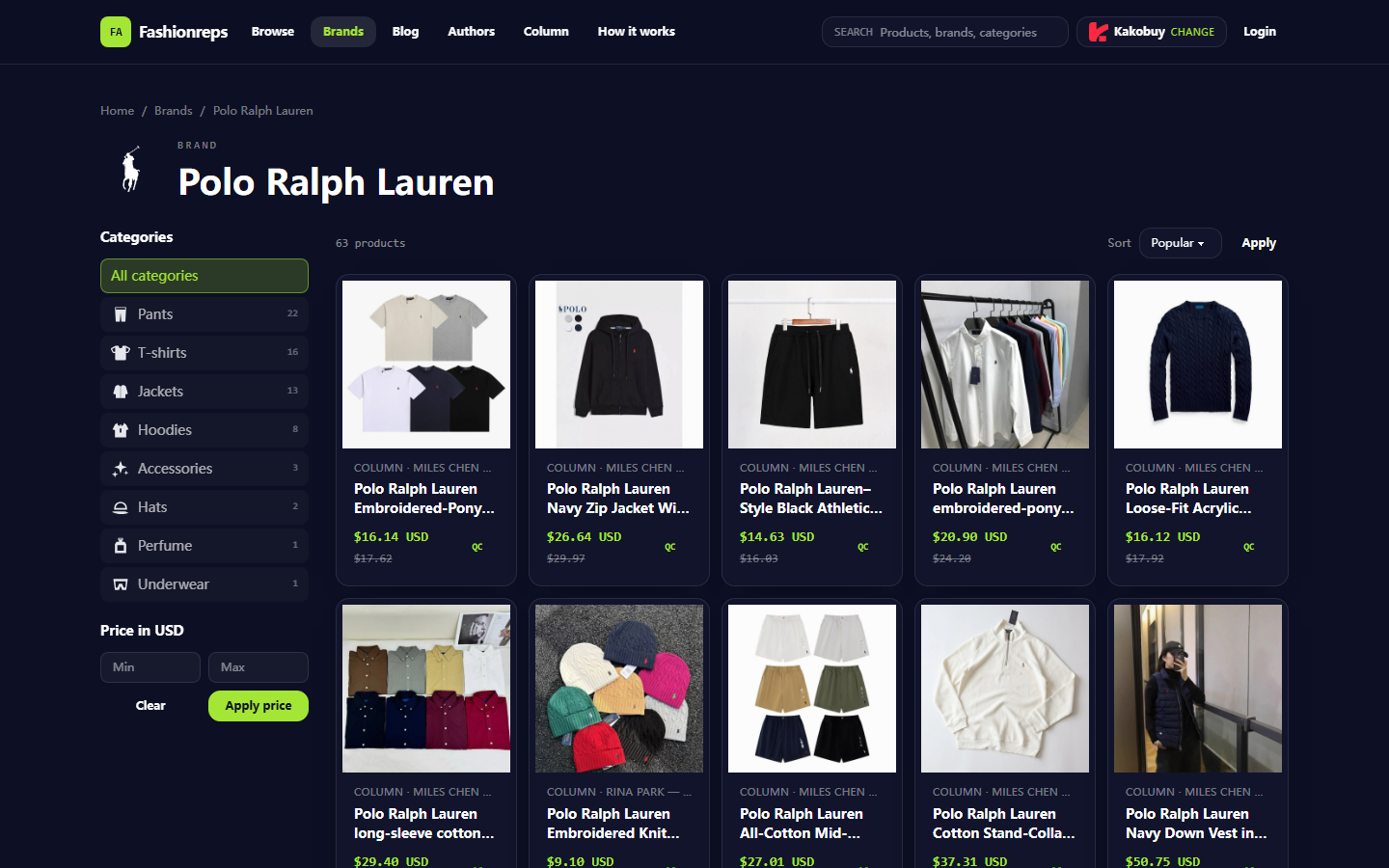
The fashionreps Polo Ralph Lauren brand page shows 63 products and provides category, price range, and sorting filters. The page also indicates that the Buy button for products goes to the selected shopping agent process, so the reference price on the page cannot be directly equated to the final payment total.
Visible knitwear-related samples on this page include:
- Loose-Fit Acrylic Crewneck Sweater, six colors, reference price $16.12.
- Cotton Stand-Collar Sweater, eight colors, sizes S–XXL, reference price $37.31.
- White Wool-and-Cashmere Crewneck, lightweight slim-fit knit, reference price $61.19.
These prices can only serve as recorded values during page verification. They do not include service fees, packaging fees, storage fees, domestic shipping, international shipping, payment processing fees, exchange rate differences, or destination country taxes, which are not provided in this material. They also cannot guarantee the lowest price or final savings.
It is recommended to record the following fields for each item separately:
- Page product name.
- Color and size.
- Reference price shown on the page and currency.
- Date the page was accessed.
- Whether the product page is still accessible and has clear specification information.
- The name of the shopping agent the Buy button leads to.
- Whether subsequent fee details are already visible.
If color, size, or product page changes, save the displayed information and pause calculation. Do not substitute with a similar style's price.
Compare Service Fee Conditions for Separate vs. Combined Checkout Using a Unified Table
First establish two scenarios:
- Separate checkout: each knitwear item creates its own order or package.
- Combined checkout: multiple knitwear items go into the same order, same warehouse processing, or same package.
Only when the shopping agent clearly shows the service fee rules for both scenarios can you perform a quantitative comparison. Focus on whether service fees are charged per item, per order, per package, by weight, or by operation type.
| Cost Item | What to Record for Separate Checkout | What to Record for Combined Checkout | Can Current Material Directly Determine? |
|---|---|---|---|
| Product price | Each item's page reference price | Sum of each item's price in combined order | Can record page value, but not final payment price |
| Service fee | Applicable conditions per order or package | Applicable conditions for combined order or package | Material does not provide specific rates |
| Packaging fee | How charged per item or per package | Whether charged by package, weight, or volume | Material does not provide |
| Domestic shipping | Fee conditions from seller to warehouse | Whether still calculated separately after combining | Material does not provide |
| International shipping | Billable weight and route per package | Actual billable weight and route after combining | Material does not provide |
| Exchange rate and payment fees | Conversion and fees per payment | Conversion and fees for single payment | Material does not provide |
Do not directly write "reduced number of orders" as "reduced costs." If service fees are charged per item, combining orders may not help; if fees are charged per package or fixed operation, combining may reduce duplicate items, but must be based on actual rates. 💰
How to Verify Packaging Method, Package Weight, and Storage Fees
Before combining, confirm whether the warehouse allows placing these knitwear items in the same package, and whether combining will change the following:
- Actual weight and billable weight.
- Package volume or volumetric weight.
- Packaging materials and reinforcement requirements.
- Storage start time and overdue fees.
- Route, product category, or package value restrictions.
- Single risk in case of loss, damage, or return.
Combining may reduce duplicate packaging or fixed operations, but it may also make a single package heavier, larger, or increase exposure to one loss. Separate checkout may increase fixed fees but can lower single-package risk or resolve route and restriction issues.
Therefore, at least obtain the actual weight, billable weight, packaging method, and storage status shown by the warehouse or shopping agent before deciding to combine. If only product page prices are available without warehouse data, you cannot calculate combined package savings. 📦
How to Record Exchange Rates, Payment Fees, and Domestic Shipping in Separate Columns
Do not directly compare USD reference prices with local currency charges on your bank card or payment platform. It is recommended to split records into four columns:
- Page product price: keep the USD amount shown on the page.
- Agent or order amount: record the amount and currency shown at checkout.
- Exchange rate conversion: record the actual exchange rate and time used by the payment platform.
- Payment surcharge: record fees shown by bank card, payment platform, or top-up channel.
Domestic shipping should also be recorded separately, because shipping from seller to agent warehouse may be unrelated to international package fees. If multiple items come from different sellers, do not assume domestic shipping will automatically combine.
An actionable total cost framework is:
Total product prices + domestic shipping + service fees + storage fees + packaging fees + international shipping + payment processing fees + exchange rate impact + legally applicable destination taxes.
If any item lacks verifiable data, mark it as "To be confirmed" and do not fill in zero. This avoids mistaking missing fees for savings.
When Combining May Reduce Duplicate Handling, and When Evidence Is Insufficient
Conditions to consider combining include:
- Each item's specifications and page status are confirmed.
- The shopping agent explicitly allows combined packaging.
- The billing units for service and packaging fees are known.
- Combined actual weight and billable weight can be queried.
- No conflicts in route, product category, package value, or destination rules.
- The estimated total cost after combining can be compared with separate scenarios using the same basis.
Cases where immediate combining is not recommended include:
- Only page reference prices available, no order or warehouse fee details.
- Specifications such as size, color, or page details of different items are still unclear.
- Combining may change billable weight, but the agent does not provide the calculation method.
- Storage time, route, or package restrictions are not confirmed.
- You cannot confirm the payment platform's exchange rate and fees.
- Combining leads to higher single-package loss risk, and insurance or compensation conditions are unclear.
Especially when the page reference price does not match the shopping agent's actual order amount, pause judgment and re-verify the product page, agent order page, and warehouse fee page. Do not use the rate of a previous item to estimate another item, and do not treat historical promotions as currently valid. ⚠️
How to Pause Judgment When Page Specifications or Fee Conditions Are Inconsistent
If you encounter any of the following, keep records and do not submit a combined plan:
- Product titles similar, but material, size range, or color options differ.
- Page is still accessible, but lacks specification information sufficient for ordering.
- Price shown as reference, without indication of update time or applicable conditions.
- Buy button leads to a different shopping agent than expected.
- Separate and combined checkouts use different routes, currencies, or billable weights.
- Service fees, storage fees, or packaging fees show only partial items.
Pausing is not giving up the purchase; it is waiting for complete evidence. You can continue verifying product specifications, agent fee pages, warehouse status, and destination requirements; do not write estimated values as actual savings until key fields are filled.
Final Action: Use a Polo Ralph Lauren Knitwear Cost Table to Decide Separate or Combined
First create a row for each knitwear item, then fill in two sets of fees: "separate checkout" and "combined checkout." For each amount, note the currency, verification date, and applicable conditions. If an item is unknown, fill in "To be confirmed," not 0.
Only choose combining when the service fees, packaging fees, storage fees, billable weight, route, and payment costs after combining all have verifiable evidence, and the total cost basis is consistent. In that case, duplicate order or package handling may be reduced, but specific savings must be calculated from your order data, not inferred from page reference prices.
If the combined plan increases single-package weight, volume, route restrictions, or one-time loss risk, it may not be suitable even if apparent operation count decreases. For orders with insufficient fee evidence, inconsistent specifications, or unconfirmed destination rules, keeping separate or delaying submission is usually more prudent.