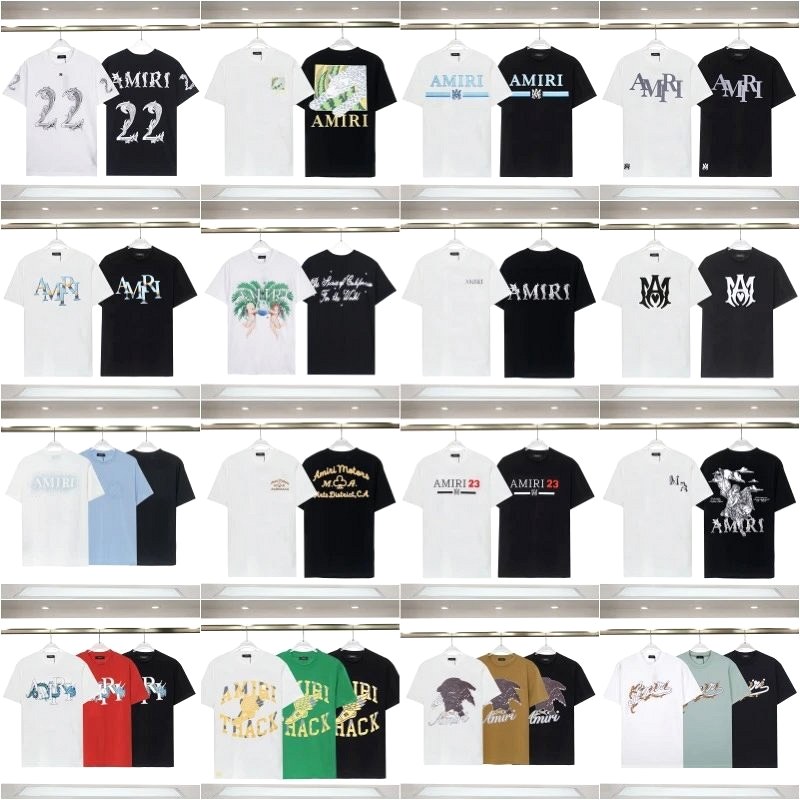
This listing sells a code before it sells a shirt. The option menu offers 55 variant rows, each written as a four-digit number plus a colour word: 827 white, 827 black, 8365 black-blue, 8252 red, D211 white. The photograph at the top of the page is one gallery covering all of them. So we ordered two size-L pieces in the same code, 827, in white and black, to separate what the code controls from what the photo implies.
What the 8xxx, 83xx and 8xxx codes appear to represent
Reading the option list as a whole, the numbers behave like artwork identifiers rather than shades of one print. A single code can carry several colour pairings — 8365 appears as black-blue, black-red, white-red and white-blue; 8302 as light blue, white and black — which suggests the code fixes the front graphic, and the word after it fixes the ground and accent colours.
| Code | Colour entries in the listing | Our read |
|---|---|---|
| 827 | white, black | Base logo layout on two grounds; the pair we tested |
| 808 / 809 | white, black (both) | Same two-ground pattern, different artwork |
| 8360 | black, white-blue, white-red | Artwork with one two-tone accent |
| 8365 | black-blue, black-red, white-red, white-blue | Four accent pairings, the widest spread |
| 8329 / 8183 | black, white, blue or red | Three-colour runs |
| 8178 / 8008 / D211 | black, white; white only | Shortest runs, least likely to be restocked |
The practical consequence is that two buyers ordering "white" can receive different front prints. That is the single most important thing we found in the option list, and it explains why the brand's own product pages lean so heavily on the warning that dye-processed Amiri tees can vary in shading and transfer colour in the wash.
Our sample, measured flat
Both size-L pieces reached us in a plain poly bag with no crush damage and no branded hangtag. We photographed them on the dated grey mat before opening, then measured each at four points against the seller's chart. The listing quotes a 1–3 cm tolerance, and our numbers sat at the low end of that band, which we read as the chart being slightly conservative rather than optimistic.
| Point | Our size L | Seller's chart | Difference |
|---|---|---|---|
| Chest, pit to pit, flat | 55 cm | 54 cm | +1 cm |
| Body length, high point to hem | 71 cm | 70 cm | +1 cm |
| Shoulder width, seam to seam | 48 cm | 47 cm | +1 cm |
| Sleeve length, shoulder to cuff | 20.5 cm | 20 cm | +0.5 cm |
| Collar rib height | 2.5 cm | not listed | — |
The side seams carry a single-needle lockstitch with roughly 0.9 cm of seam allowance and a twin-needle hem. The collar is a separate ribbed band rather than a folded self-fabric neck, and it recovered its shape after stretching across a 52 cm collar opening. Whole-garment weight was 218 g on our gram scale, which sits comfortably inside the stated 180–250 g/m² band and matches the "heavier than a standard tee" impression reviewers of Amiri cotton tees keep repeating.
The print, before and after one cold wash
The graphic is a surface dye print, so the ink film sits on top of the cotton rather than in the yarn. Under a 10x loupe the edges were clean at the letter terminals, with light bleed-through visible on the reverse of the front panel. We gave the print edge a thumbnail scratch: it took firm pressure to disturb anything, and no flakes lifted.
After one cold wash inside out, hung to dry, the print was unchanged in colour and unbroken. Shrinkage was modest and inside the stated tolerance: length −1.0 cm, chest −0.5 cm, sleeve −0.5 cm, collar rib unchanged. A second and third cold wash produced no further movement.
What we could not confirm, and what that means for an order
There is no independent buyer feedback on this exact listing, so durability rests on third-party reports about Amiri tees generally. One authorized-retailer buyer reported the printed lettering cracking noticeably within roughly 18 months of limited wear and dry cleaning as instructed — a single report, not a failure rate. Another buyer reported a metallic smell appearing after a few months that survived washing; our sample had no odour out of the bag or after three washes, but we cannot rule out a batch issue. In QC threads, buyers also debate the printed logo shade, saying it can look more faded than the brighter yellow some expect, which makes matching a shade against reference photos difficult.
None of that is testable on one parcel. It is the reason we treat the print, not the cotton, as the variable on this shirt.
How we would order it again
- Pick the code first, then the colour word. Send the agent both, in the exact format from the option list.
- Request a QC photo of your specific code, front print, in daylight, before the parcel ships.
- Ask for a flat chest and length measurement in the size you want; buyers say Amiri tops generally run slightly small, so sizing up is the common recommendation.
- Wash cold, inside out, no dryer, and never iron directly on the graphic.
At $8.36 (down from $9.87) the cotton is the low-risk part of the purchase. The print is where your money is actually bet.
How we tested
We ordered two size-L pieces in code 827, photographed the parcel on the dated grey mat before opening, and measured chest, length, shoulder, sleeve and collar rib flat against the seller's chart. Both went through one cold wash with a re-measure, and the print was checked with a 10x loupe and a thumbnail scratch test before and after.
Sources and notes
- Catalog product page
- Product listing verified on 2026-10-12.
What do the colour codes like 827 and 8365 actually mean?
Each code looks like a separate print artwork, with the word after it naming the colour pairing — 8365 appears as black-blue, black-red, white-red and white-blue. Codes are not interchangeable shades of one print, so confirm the artwork before you order.
Why does the listing photo not match the code I receive?
One photo gallery covers all 55 option rows, so it cannot show each variant. Ask your agent for a QC photo of the specific code you ordered — front print, daylight, unfolded — before the parcel ships.
How do I check print adhesion when the parcel arrives?
Look at the print edge under a light: lifting, fine ridges or a matte halo suggest weak adhesion. Bend the fabric over your thumb at the print edge, since cracking there would echo the third-party report of lettering failing at about 18 months.